
Most people struggle with food not because they lack discipline, but because their meals are complicated. Too many ingredients, too many cooking steps, too many sauces, too many decisions. The more decisions you make, the harder eating becomes.
Simple meals change that. When you base your eating around meat, eggs, raw or minimally processed dairy, fruit, and clean fats, it becomes easier to stay consistent, feel steady, and enjoy your food without tracking anything.
This guide gives you a simple framework you can repeat every day, whether you want better structure, fewer cravings, or just a calmer relationship with food.
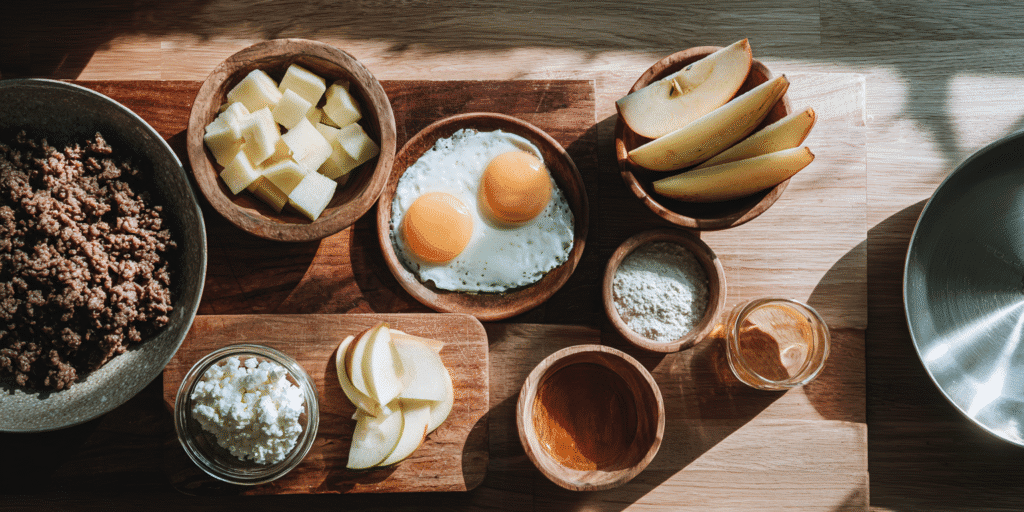
Why Simple Meals Work in a Modern World
Simple eating is not about limiting yourself. It is about removing friction.
Most people feel overwhelmed by eating because meals include:
- Too many ingredients
- Processed oils
- Hidden sugars
- Low quality additives
- Complicated preparation
When you scale meals back to real food, you get:
- Fewer decisions
- Easier preparation
- Better nutrient density
- A more predictable response from your body
Simple meals are not a trend. They are a return to how humans ate for most of history.
The Simple Meal Framework
Here is the foundation you can use every day. It stays the same whether you are cooking breakfast, lunch, or dinner.
Step 1, Choose a protein
This is the anchor of your meal. Choose one.
- Ground beef
- Steak
- Whole eggs
- Chicken thighs
- Lamb
- Wild caught salmon
- Sardines
- Cottage cheese or Greek yogurt if you tolerate dairy
Protein gives stability, satiety, and essential nutrients your body uses all day.
Step 2, Add a clean cooking fat
Use fats that hold up well to heat and support simple, whole food eating.
- Butter
- Ghee
- Beef tallow

4th & Heart Ghee
A rich lactose-free clarified butter made from grass-fed cows that gives you a smooth nutty flavor and a clean high-heat cooking fat. It is perfect for sautéing, roasting, or adding creamy depth to coffee and meals while supporting gut and metabolic health.

Forward Farms Beef Tallow
Forward Farms Beef Tallow is a pure, natural cooking fat made from grass-fed cattle that delivers rich flavor and exceptional high-heat stability. It is perfect for frying, roasting, and adding nourishing depth to everyday meals while supporting a clean ancestral way of eating.
Avoid seed oils like canola, soybean, or vegetable blends, especially at high heat.
Step 3, Add clean carbohydrates if you want them
You don’t need complicated starches. Fruit and raw honey offer easy to digest, natural sugars.
- Berries
- Pineapple
- Mango
- Grapes
- Apples
- Raw unfiltered honey
If you enjoy them, optional foods like sourdough bread or white rice can work for some people.
Step 4, Use a mineral-rich salt
Salt brings minerals and makes simple food taste great.
This four step method keeps meals predictable and eliminates decision fatigue.

Baja Gold
Baja Gold Mineral Salt is an unrefined sea salt harvested from the nutrient-rich waters of the Sea of Cortez, offering a naturally balanced blend of trace minerals and a smooth, clean flavor. It enhances hydration, supports mineral balance, and adds pure ocean-sourced seasoning to any meal.

Redmond Real Salt
Redmond Real Salt is an unrefined ancient sea salt mined in the USA that contains its natural trace minerals and a clean, mildly sweet flavor. It supports electrolyte balance, enhances hydration, and adds pure mineral-rich seasoning to any dish.
Simple Meal Examples You Can Use Right Away
Everything here is built from the framework above, so you can mix and match ingredients without needing detailed recipes.
Breakfast
- Ground beef cooked in butter with two eggs on the side, plus blueberries
- Scrambled eggs with raw cheese and sliced strawberries
- Yogurt with raw honey and a piece of fruit, with a side of leftover steak
Lunch
- Cast iron steak with pineapple
- Wild caught salmon cooked in ghee with a bowl of mixed berries
- Chicken thighs with mango and a spoon of cottage cheese
Dinner
- Burger patties topped with cheese and a handful of grapes
- Lamb chops cooked in tallow with sliced melon
- Ground beef bowl with cottage cheese and fruit on the side
You can rotate these ideas all week without feeling bored because the ingredients are flexible and the flavors stay fresh.
Why This Works Even If You’re Busy
You don’t need hours of prep. You only need:
- A cast iron or Stainless steel pan
- A protein you can cook in 10 minutes
- A piece of fruit
- Some salt
Most meals take less time than ordering takeout.
The simplicity also removes the need for strict rules, calorie counting, macros, or complicated meal plans.
What About Snacks
Simple snacks are just smaller versions of the meals.
Try:
- Fruit and cheese
- Yogurt with honey
- Leftover burger patty
- Hard boiled eggs
Keep it whole food, keep it simple.
Optional Add-Ons
If you want convenience or extra support, you can use options like:
- Freeze dried organ supplements
- Electrolyte drops or Trace minerals
- Raw honey as a natural sweetener
- Heavy duty cookware that heats evenly (Cast Iron or Stainless steel)
These are not required, but many people enjoy the ease they add to a whole food lifestyle.
A Simple Takeaway
Most people do better with fewer decisions, not more rules. Simple meals remove the noise and let you focus on foods your body understands.
If you build most of your meals from protein, clean fats, fruit, and mineral rich salt, you will have a structure that is sustainable, flexible, and easy to follow every day.
You do not need perfection. You just need consistency.
Frequently Asked Questions
Do I need to follow strict portions
No. Start with a protein serving that satisfies you, then adjust fruit and fat based on your appetite.
Can simple meals work with an animal based approach
Yes. This style of eating is built on meat, eggs, dairy, and fruit. It fits perfectly.
Do I have to cook everything myself
Not always. You can choose simple dining options like plain grilled meat and fruit on the side.
Can I repeat the same meals every day
Absolutely. Many people find it easier and more predictable.
Sources
Hall, K. D., et al. Ultra-Processed Diets Cause Excess Calorie Intake and Weight Gain. Cell Metabolism (2019).
Leidy, H. J., et al. The Role of Protein in Weight Loss and Maintenance. American Journal of Clinical Nutrition (2015).
Paddon-Jones, D., et al. Protein, Weight Management, and Satiety. Nutrition & Metabolism (2008).
Fardet, A. Minimally Processed Foods and Satiety. Food & Function (2016).
Monteiro, C. A., et al. Ultra-Processed Foods and Public Health. Public Health Nutrition (2018).
Dhar, R., & Simonson, I. Decision Fatigue and Choice Overload. Journal of Consumer Research (2003).
Blundell, J. E., et al. Appetite Control and Nutrition Strategies. Nutrition Research Reviews (2010).
Slavin, J. L. Carbohydrates and Digestive Health. Nutrients (2013).
Santoro, A., et al. Nutrient Intake and Gut Health. Nutrients (2018).
Leave a Reply